Tuesday, 16 November 2010

Words Have No Meaning.


One of the great false assumptions that marketers make is that once you have someone's attention, then you've got them for good. Well I hope most marketers don't think that way, but I can't think of another explanation for this billboard ad I saw at a station today. Just look at all those words.

It starts with a few superfluous humanising sentences about how they used to be bad at explaining things but they're trying much harder now and then goes on to explain how. Thereafter they probably telling me some more of their greatness, but even I (with a blogpost in mind) couldn't be bothered to read further. In fact, I was bored after the first sentence - it was all about them and nothing about what they could do for me.

It's the sort of worthiness that would be ignored in a magazine or newspaper where the next page is crying out for your attention; around a billboard the number of distractions are even greater and yet they want to preach to me - if not in tone, certainly in verbosity.

If you want to transmit information in an ad, then think elevator pitch in a very fast elevator. Know what you want to say and say it quick and clearly. That way you might keep my attention.

Wednesday, 10 November 2010

Customer Service Insight.

Tonight, amongst other nonsense, I heard a creative director declare that twitter could be a great customer service tool. No it can't. It can be a great customer mood monitor, it can be a great way to field customer complaints, but that's not what we should understand as customer service.

Customer service is what happens throughout your contact with the customer. If you do it right, you shouldn't need to have a Twitter presence because your customers will be happy.

Thursday, 4 November 2010

Why Targetting Is The Wrong Marketing Mindset.


In a presentation today, Microsoft's president of online search Dr Qi Lu emphasised the need for their focus to be on user experience rather than driven by data.

But what troubled me was that he kept using the dreaded words consumer and targetting and implied that effective targetting of consumers was the marketer's holy grail. Indeed, he spoke ominously of the creation of "computational behavioural models to predict human intent".

Targetting just oozes all the wrong connotations: the passive customer, the picking off of individuals as they stray into your corporate cross-hairs, not to mention the assumption that you know how all customers behave.

It's too confrontational, too aggressive and too interruptive - even if I search for your product online, it doesn't mean I want you to market to me right now. You don't and cannot know my motivation.

Far better then to use all these technological capabilities of which Dr Lu spoke to be constantly available/accessible, to be where the prospective customer is likely to be and to be listening for their cues.

Reverse the metaphor. Think of your product/service as the customer's target and your marketing as a way of perfecting their aim.

Thursday, 28 October 2010

Why 360 Marketing Sends You Round In Circles.


My friend who carried this bag had no idea what it meant - she just liked the bag. To me it was simply a further outbreak of the 360 plague that infects our world to very little marketing effect.

Whenever I see it, I am struck that while I know it's meant to indicate something like constant interaction, it primarily reminds me that 365 is a much better known number - and thus 360 seems like taking 5 or 6 days off. It seems to be a diminished claim.

It's all very well for marketers to think they understand what 360 means in their world, but that's not enough to justify pasting it everywhere regardless of the sub-context, under the assumption that your customers understand it and in the misguided belief that it will aid differentiation. That way leads to things like Vodafone360 People.


Vodafone 360 People "brings all your friends together backed up in one place" which I'm not sure has much at all to do with the generally agreed 360 ideal. It strikes me that it's simply been bundled under the heading of Vodafone 360 that they advertise heavily in stores and brochures. It's the branding equivalent of scrambling around for some copy to fill the media space you belatedly realise you've bought. To confuse things further, they also promote Vodafone 340 in the same places. And no, that's not 360-lite. It's simply a phone.

I'm all for marketing making the meme, but when the meme's making the marketing, you've got problems.

Monday, 25 October 2010

Don't Treat Customers As Revenue Sources.


My mobile phone provider frequently fills my time with irrelevant offers designed to bring them more revenue. My mobile phone provider also knows I make a lot of international calls. But when they implemented a new international call plan six months ago, they failed to tell me about it. As someone admitted, "they don't shout about it".

Presumably, they don't expect their customers to shout about it, but I did.

Firstly on the phone where I had to endure a whole bunch of security questions despite making it clear at the outset that I was just seeking to clarify when the plan was implemented.

That just served to remind me of the insurance company with which I once worked. They discovered that they asked a woman more than twenty scripted questions when she rang their emergency claim line before they got to the important question are you ok? At the time she was less than ok - her house was burning down in front of her along with the policy details they were demanding.

Then I tried by letter. I addressed it by name to the customer service director, but received a written response from someone else. Its first words? "Good Morning" followed by an acknowledgment that I had now signed myself up to the plan and the implication that all was now well.

That just served to give me the impression they were an outsourced worker with no authority to deal with my query (other than to fob it off). It also made me realise that this customer was in the middle of a common pincer movement comprised of a cost-cutting exercise and a revenue-maximising approach.

Yes, it maximises marginal profit. But in a world of inert (and thus continually profitable) customers, your focus should be on making them more inert. You really should avoid giving them reasons to contemplate leaving you.

Monday, 18 October 2010

Marketing's Digital Obsession.


Marketers have realised that women are the key purchase decision-makers. Marketers have belatedly begun to realise that demography is skewed to the elderly (even though economics classes were pointing that out twenty years ago. Marketers will eventually have to acknowledge that technology is a tool and not the the reason for the behaviour. But in the interim, we'll have to endure a lot of nonsense like digital paper.

How ever fine or specially treated it may be; what ever digital machine you might insert it in; regular paper is and always will be analogue not digital. To suggest otherwise is just another example of marketing's obsession with newness. An obsession that's arguably even worse than its fixations on youth and authenticity. A product-focussed logic not a customer-centred one.

People don't necessarily want new. They want better. If your new is better then that's great, but make sure it is. All too often, new is complicated, functionally-bloated and impenetrable. Or just more expensive. Better may derive from innovation, but never forget that innovation doesn't have to be technological. It's just as likely to mean a different way of looking at what already happens.

So be careful that your focus on modernity isn't lazy marketing shorthand, underwritten with the belief that the public can be blinded with science.
You may just be revealing your technology fetish and the fact that you don't understand the true nature of the technology, the reasons why your customers do what they do and their familiarity with the concept of the emperor's new clothes.

New may well seem or indeed be different, but that doesn't mean it's a source of viable differentiation.

Monday, 11 October 2010

Marketing Words Are Not Enough.


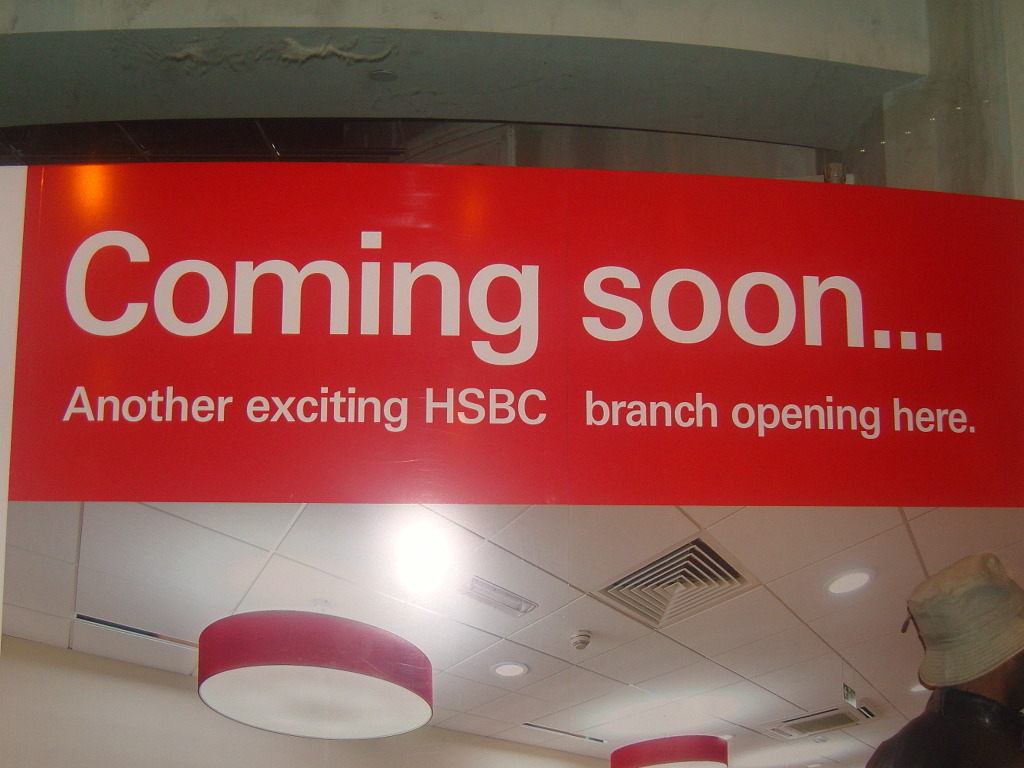
It's a bank, not a roller-coaster and self-delusion like this is the marketer's worst enemy. Enthusiasm may seem great in meetings, but it's the customers who decide and it's obvious that excitement isn't at the top of their banking needs.

Moreover, I guarantee your branch will not be exciting and if you over-promise, you're bound to under-deliver.